Bob told Dan and Steve –
“My grandmother, and your great grandmother, Mary Rose Adams Craig told me about Haym Salomon when I was a kid. Grandmother Craig told me that he may have loaned money for the American revolution and we might be entitled to some payouts if there were ever any.
So now after 70 years, we can learn more about the life of this man, and who Grandma Craig told me was our ancestor. And this shows the wonders of my Google research!”
https://www.nps.gov/revwar/about_the_revolution/haym_saloman.HTML
https://en.wikipedia.org/wiki/Haym_Salomon
Haym Salomon (ca. 1740 – 1785)
by Bob BlytheImage: Haym Salomon (sometimes written as Solomon and Solomons in period documents) was a Polish-born Jewish immigrant to America who played an important role in financing the Revolution. When the war began, Salomon was operating as a financial broker in New York City. He seems to have been drawn early to the Patriot side and was arrested by the British as a spy in 1776. He was pardoned and used by the British as an interpreter with their German troops. Salomon, however, continued to help prisoners of the British escape and encouraged German soldiers to desert. Arrested again in 1778, he was sentenced to death but managed to escape to the rebel capital of Philadelphia, where he resumed his career as a broker and dealer in securities. He soon became broker to the French consul and paymaster to French troops in America.
Salomon arrived in Philadelphia as the Continental Congress was struggling to raise money to support the war. Congress had no powers of direct taxation and had to rely on requests for money directed to the states, which were mostly refused. The government had no choice but to borrow money and was ultimately bailed out only by loans from the French and Dutch governments. Government finances were in a chaotic state in 1781 when Congress appointed former Congressman Robert Morris superintendent of finances. Morris established the Bank of North America and proceeded to finance the Yorktown campaign of Washington and Rochambeau. Morris relied on public-spirited financiers like Salomon to subscribe to the bank, find purchasers for government bills of exchange, and lend their own money to the government.
From 1781 on, Salomon brokered bills of exchange for the American government and extended interest-free personal loans to members of Congress, including James Madison. Salomon married Rachel Franks in 1777 and had four children with her. He was an influential member of Philadelphia’s Mikveh Israel congregation, founded in 1740. He helped lead the fight to overturn restrictive Pennsylvania laws barring non-Christians from holding public office. Like many elite citizens of Philadelphia, he owned at least one slave, a man named Joe, who ran away in 1780. Possibly as a result of his purchases of government debt, Salomon died penniless in 1785. His descendants in the nineteenth century attempted to obtain compensation from Congress, but were unsuccessful. The extent of Salomon’s claim on the government cannot be determined, because the documentation disappeared long ago.
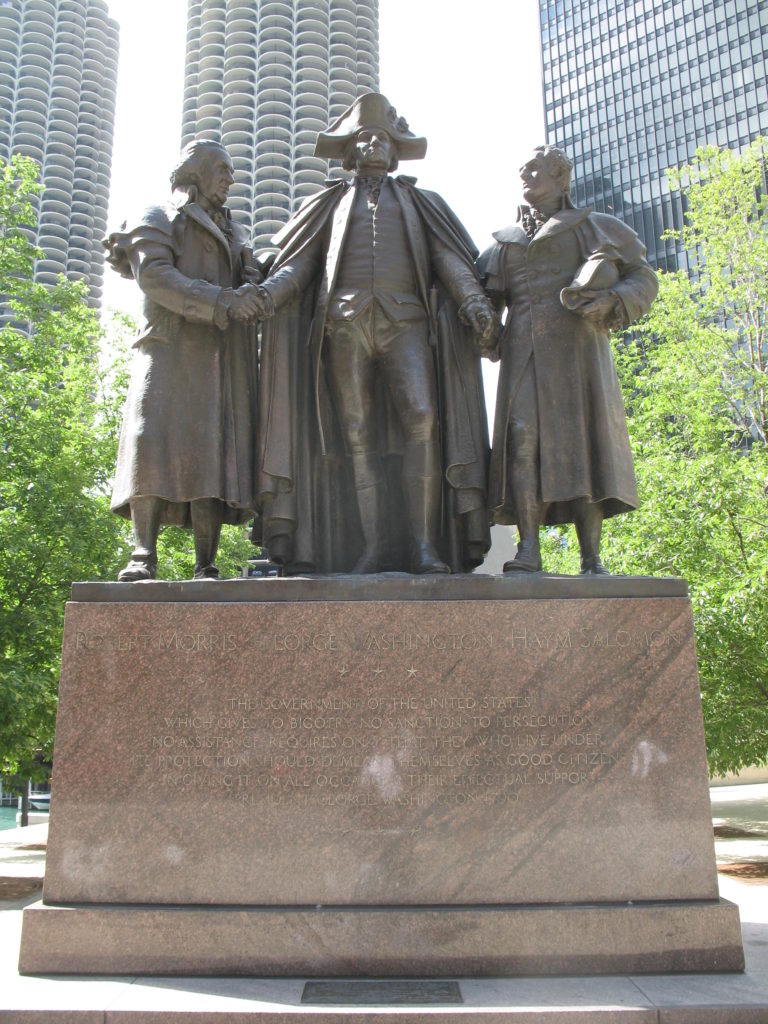
In 1941, the George Washington-Robert Morris-Haym Salomon Memorial was erected along Wacker Drive in downtown Chicago. The bronze and stone memorial was conceived by sculptor Lorado Taft and finished by his student, Leonard Crunelle. Although Salomon’s role in financing the Revolution has at times been exaggerated, his willingness to take financial risks for the Patriot cause helped establish the new nation.
On the back of the one dollar bill, if you notice the arrangement of the 13 stars in the right-hand circle you will see that they are arranged as a Star of David. This was ordered by George Washington who, when he asked Haym Solomon, a wealthy Philadelphia Jew, what he would like as a personal reward for his services to the Continental Army, Solomon said he wanted nothing for himself but that he would like something for his people. The Star of David was the result. Few people know that it was Solomon who saved the Army through his financial contributions but died a pauper.
To learn more:
Laurens R. Schwartz, Jews and the American Revolution: Haym Salomon and Others (Jefferson, N.C.: McFarland & Co., 1987).